Representatives and executive leadership of Imam Sadiq Academy convened at the office of His Eminence Ayatollah Alavi Boroujerdi. During the audience, the delegation delivered an executive briefing highlighting the Academy’s global progress, pedagogical milestones, and strategic initiatives in international sphere.
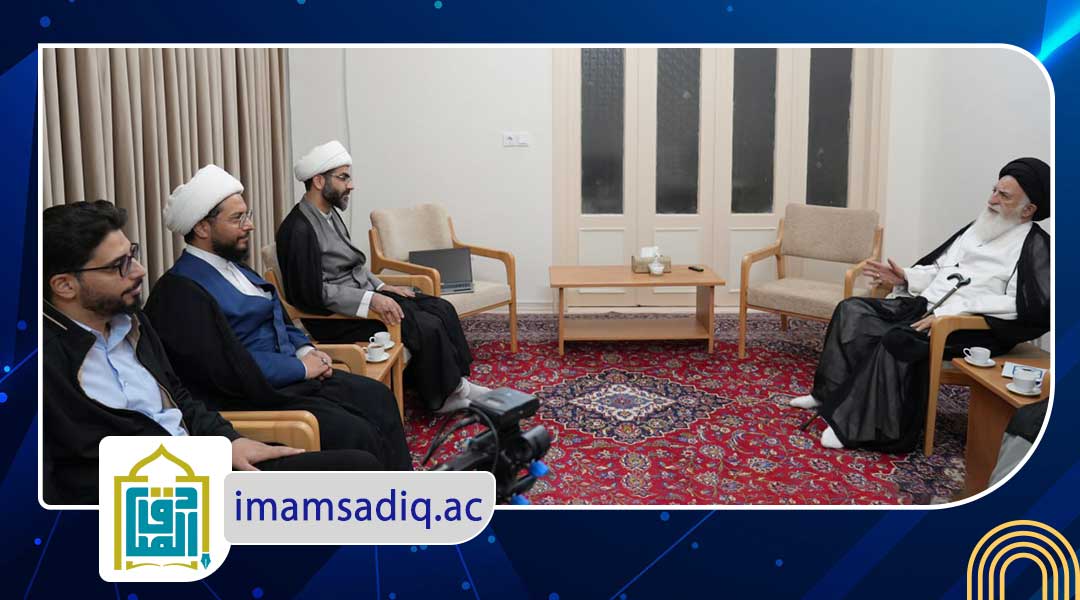
At the outset of the meeting, the delegation introduced the various departments of the institution and outlined key activities of Imam Sadiq Academy in its role as an international digital platform for Islamic studies education.
Expanding Islamic Studies Education Through a Multilingual Digital Platform
During the meeting, emphasis was placed on the Academy's educational initiatives, which cater not only to seminary (Hawza) scholars, but also provide instructional content for a broad spectrum of Islamic knowledge seekers outside Iran—including university students, women, and converts to Shia Islam (Mustabsirun).
Regarding seminary instruction, Imam Sadiq Academy hosts an extensive repository of classical Islamic curricula. The collection spans from foundational Hawza studies to advanced post-graduate lectures (Bahth al-Kharij) delivered by distinguished jurists of Qom and Najaf. Offered with the scholars' formal consent, these courses are accessible in multi-media audio-visual formats tailored to students' academic needs.
Among the Academy’s primary features is its active expansion of educational content across multiple languages. At the time of this report, courses are offered in approximately 11 languages, with plans underway to expand this capacity to 25 languages. Furthermore, the platform’s translation infrastructure enables the translation, production, and publication of books and educational materials in languages such as English, Arabic, Urdu, Swahili, and others.
Platform Metrics: Overview of Registered Learners, Instructors, and Participating Institutions at Imam Sadiq Academy
Subsequent reporting highlighted the steady growth of the Academy’s global audience. According to figures presented during the meeting, the number of active users participating in educational courses has reached over 31,000, while total registered platform users have exceeded 40,000.
Concurrently, the Academy's network of scholars and educational partners has experienced substantial growth. To date, more than 300 distinguished professors have collaborated in course delivery across the platform. Furthermore, Imam Sadiq Academy has established joint operational frameworks with around 42 educational institutions, providing them with a dedicated, state-of-the-art platform to publish and disseminate their scholarly curricula to international audiences.
Another key feature of this pedagogical model is providing an ecosystem that extends beyond simple media hosting. Audio and video lectures are seamlessly integrated with interactive exercises, assessments, course certifications, and supplementary learning tools to deliver a complete instructional experience. Furthermore, the delegation highlighted the integration of modern technologies—particularly artificial intelligence—into the learning process as a major focus of the Academy's ongoing development.
Imam Sadiq Academy’s Extensive Experience in Inmate Education and Outreach in the United States
Another segment of the meeting highlighted one of the institution's distinctive international initiatives in the United States: a program established to maintain academic and educational engagement with prison inmates, addressing their theological (Aqa'id) and jurisprudential (Fiqh) inquiries.
Initially conducted through written correspondence and book distribution, this initiative has established contact with over 4,000 inmates over a period of roughly ten years. Within this framework, books are curated according to the recipient's reading level, and participants are requested to submit summaries of their assigned readings to track their educational progress. According to the report presented, hundreds of letters containing theological queries, legal rulings (Ahkam), and requests for instructional materials are received monthly from these correspondents.
The initiative achieved a pivotal milestone with the introduction of secure educational tablets across several American prison systems, enabling direct digital access to Imam Sadiq Academy’s specialized e-learning portal. Analytics presented during the briefing revealed substantial engagement, including approximately 900,000 individual video plays and nearly 500,000 full video completions, alongside exceptional enrollment rates in specialized modules on Ahl al-Bayt (a.s.) doctrine.
Furthermore, delegation leaders noted that a vital operational branch of this outreach involves localizing, translating, and circulating foundational Islamic and theological texts into multiple global languages, custom-tailored to address the intellectual requirements of incarcerated learners.
Expanding Educational and Outreach Engagement with Shia Communities Abroad
During the meeting, the delegation also detailed the institution's outreach activities across Europe and the establishment of the 'Al-Majlis' project. Launched to support families, home-based gatherings, and select Islamic centers across European nations, this initiative addresses challenges in regions where financial, geographical, or logistical constraints prevent the continuous deployment of resident scholars and in-person programming.
Under this framework, live virtual connections enable scholars and public speakers to engage directly with home gatherings and families, facilitating continuous access to the teachings of the Ahl al-Bayt (peace be upon them) and religious education. The initiative has been implemented in countries such as Sweden, Germany, the Netherlands, and Turkey, with its inaugural gathering held on the auspicious occasion of Eid al-Ghadir.
Endorsement: Ayatollah Alavi Boroujerdi Underscores the Global Reach and Strategic Potential of Imam Sadiq Academy
Following the presentation, Ayatollah Alavi Boroujerdi evaluated the Academy’s multidimensional scope, emphasizing its crucial role in addressing the academic needs of seminary scholars and seekers of Islamic knowledge worldwide.
Pointing to the challenges faced by many students and enthusiasts worldwide in physically attending traditional Islamic seminaries in Iran—particularly in certain foreign nations—Ayatollah Alavi Boroujerdi stated that the Academy possesses the vital potential to help establish a 'global seminary' (Hawza). Furthermore, by enabling learners across different countries to access lectures by prominent scholars, he described the institution as holding the capacity of a monumental international university.
His Eminence placed special emphasis on the foundational role of theological education and doctrinal clarity, especially when addressing international constituencies and Mustabsirun. He underscored that religious knowledge must be pedagogical and calibrated to match the intellectual baseline and nuanced needs of diverse student demographics. In particular, addressing the spiritual and doctrinal questions of Mustabsirun through bespoke educational content was highlighted as a paramount imperative for contemporary Islamic cultural and academic institutions.
Comments (0)

Categories
Recent posts


دینی مدارس کی قابل ...
8 Sep 2025
دوره «مسئله علم امام» ...
8 Apr 2025
طالب علم کے لئے ...
8 Sep 2025


