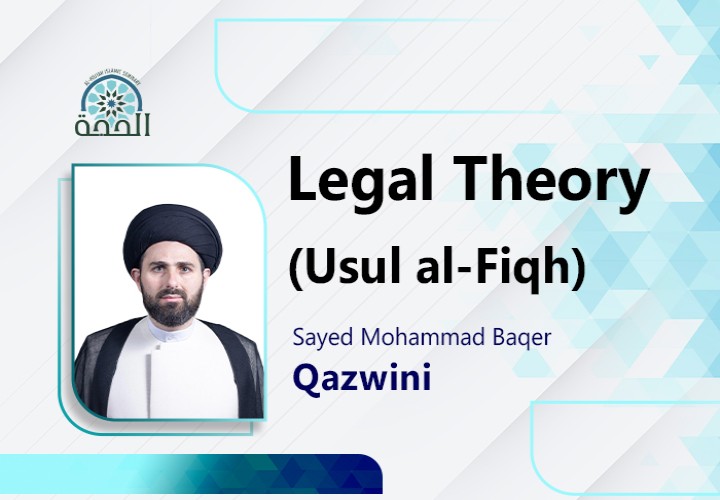
Legal Theory - Usul al-Fiqh
dalam Usul Fiqh Pertengahan
Tentang kursus ini
Legal Theory - Usul, taught by Sayed Mohammad Baqer Qazwini, provides a detailed study of Usul al-Fiqh, the science of principles used to understand and derive Islamic legal rulings. The course examines the foundations of Fiqh, methods of interpreting textual evidence, legal proofs, principles of practical law, and approaches to resolving uncertainty and conflicting narrations.
Introduction to Usul al-Fiqh
The course begins with an introduction to the science of Usul, its common elements, early works, and historical development. It examines the definition of Fiqh and Usul al-Fiqh and explains Usul as the methodological framework or "logic" through which Islamic legal rulings are studied and derived.
Linguistic Principles and Legal Meaning
A substantial part of the course examines how language is used to understand legal texts. Topics include certainty (Qat'), the relationship between words and meanings, usage of words, literal and metaphorical meanings, nominal and particular meanings, linguistic signification, imperative forms, absoluteness (Itlaaq), general and absolute expressions, conditional clauses, and implied meanings.
Legal Proofs and Their Authority
The course studies several important sources and forms of legal evidence, including the authority of apparent meanings, Ijmaa' (consensus), popular juristic opinion (Shohrah), the practice of Muslims and rational people, and the validity of solitary reports. It also examines questions concerning the relationship between obligation and prohibition and whether prohibition entails the invalidity of an act.
Principles of Practical Law
The course provides an extended study of Bara'ah (the rational law of exemption) and its application in Islamic legal reasoning. It covers its Qur'anic and hadith evidence, the Hadith of Raf' (Lifting), summary knowledge (Ilm Ijmaali), interconnected obligations, and the question of choosing between exemption and precaution.
Istishab and Legal Uncertainty
Another major section focuses on Istishab, including its history and sources, different types of general Istishab, doubt concerning the Rafi' and Muqtadhi, and its application in situations of uncertainty.
Conflicting Hadith and Taqiyyah
The final part examines contradictions between legal proofs and the factors that can lead to discrepancies between hadith. It discusses general and specific causes of hadith discrepancy, narrations issued in Taqiyyah, and the accepted tradition of Umar ibn Hanzala.
Learning Materials
Each session includes a PDF containing the important points of the lesson and a multiple-choice quiz to help learners review the material and assess their understanding.